
2026/1/23
In 2025, amid heightened global uncertainties, including slowing world economic growth, rising unilateralism and protectionism, and severe disruptions to the international trade order, China’s textile and apparel industry is rising forward against headwinds, demonstrating remarkable resilience.
According to China’s General Administration of Customs, the country’s total exports of textiles and apparel reached US$293.77 billion in 2025, seeing a 2.4% year-on-year decline. Among them, textile exports amounted to US$142.6 billion, up 0.5% year-on-year; apparel exports totaled US$151.12 billion, down 5.0% year-on-year.
In CNY-denominated terms, China’s total textile and apparel exports stood at 2.1 trillion yuan, seeing a 1.9% decrease compared to 2024. Thereinto, textile exports reached 1 trillion yuan, up by 1.0% year-on-year; apparel exports amounted to 1.1 trillion yuan, down by 4.4% year-on-year.
Figure 1: Monthly Statistics of China’s Textiles and Apparel Exports in 2025
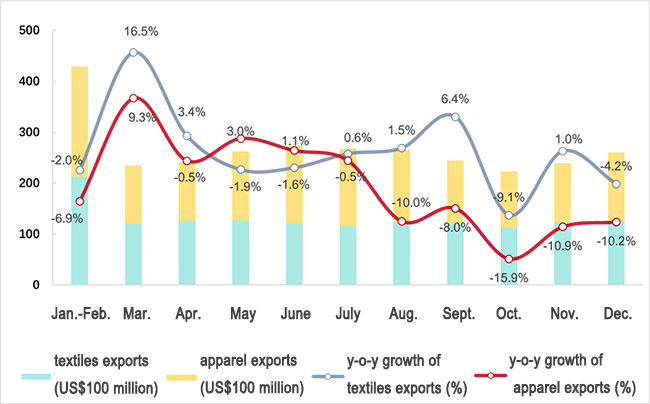
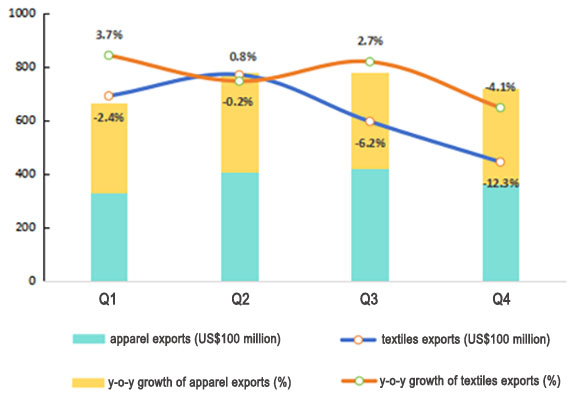
Reviewing the trade trend throughout 2025, China’s textile and apparel exports showed a volatile downward trajectory from August onward, influenced by fluctuations in international market demand and an increasingly challenging external policy environment. In the first quarter, China’s textile and apparel exports totaled US$66.28 billion, up 0.6% year-on-year, maintaining a historically high level. In the second quarter, the external environment tightened further. Frequent adjustments to U.S. tariff policies exerted noticeable pressure on China’s exports, leading to a moderation in growth momentum. From the second half onward, export trends for textiles and apparel diverged significantly. Shipments of intermediate textile products, such as yarns and fabrics, remained relatively stable with steady growth, while exports of finished garments began to contract. By the fourth quarter, both categories entered negative growth territory. Notably, apparel exports saw their year-on-year decline widen to 12.3%.
Figure 2: Quarterly Export Statistics of Textiles and Apparel in China, 2025
Currently, the global trade landscape is experiencing significant shifts. Major advanced economies are increasing policy measures focused on supply chain security and industrial competitiveness, thereby imposing ongoing restrictions on export-driven sectors. Institutions like the International Monetary Fund (IMF) and the Organization for Economic Co-operation and Development (OECD) generally agree that the global economic recovery will continue to face major uncertainties in the near future, and a substantial improvement in the trade environment is still some time away.
Looking ahead to 2026, although the international trade climate remains complex and challenging, and China’s textile and apparel exports will likely face multiple pressures in the short term, the industry retains robust long-term competitive advantages. These stem from its comprehensive industrial ecosystem, world-leading innovation capacity, and a highly efficient, integrated supply chain network.
In response to this changing landscape, China’s textile exporters are deepening their integration into global value chains by continuously optimizing product portfolios, actively innovating trade models, and vigorously expanding into diverse markets. These efforts are steadily strengthening the sector’s risk resilience and adaptability. Building on a solid foundation in foreign trade, China’s textile industry is moving toward the higher end of the global value chain, aiming for higher-quality, more sustainable development.
Source: CHINA TEXTILE LEADER Express


Authority in Charge: China National Textile and Apparel Council (CNTAC)
Sponsor: China Textile Information Center (CTIC)
ISSN 1003-3025 CN11-1714/TS

© 2026 China Textile Leader, all rights reserved.
Powered by SeekRay