
2026/4/22
In the first two months of 2026, the global economy remained on a slow-growth trajectory, with recovery hampered by geopolitical tensions, trade protectionism, and weak aggregate demand. Domestically, the economy got off to a strong start, with production and demand rising steadily and positive momentum continuing to build. China’s technical textile industry also started the year on a strong footing, with industrial value-added growth rebounding significantly.
Production
The output of major products continued to grow. According to the National Bureau of Statistics, the output of nonwovens and tire cord by enterprises above designated size increased by 7.1% and 5% year-on-year, respectively in January-February. Notably, the year-on-year growth rate of tire cord output turned positive for the first time since May 2025.
Economic Efficiency
Major economic indicators of the industry have all improved. According to the National Bureau of Statistics, the operating revenue and total profits of technical textile enterprises above designated size increased by 4.5% and 4.3% year-on-year, respectively, in the first two months; the operating profit margin was 3.6%, unchanged compared to the same period in 2025.
By sector, the operation of enterprises above designated size in January-February was as follows:
Nonwovens: operating revenue and total profits increased by 2.5% and 25% year-on-year, respectively, with an operating profit margin of 3.1%, up 0.6 percentage points year-on-year.
Ropes, cables, and cords: operating revenue and total profits grew by 8.8% and 11.9% year-on-year, respectively, with an operating profit margin of 3.3%, up 0.1 percentage points year-on-year.
Textile belts and tire cord: operating revenue and total profits decreased by 1.7% and 19.7% year-on-year, respectively, with an operating profit margin of 2.3%, down 0.5 percentage points year-on-year.
Tarpaulins and canvas: operating revenue increased by 12.7% year-on-year, while total profits decreased by 13.1%, with an operating profit margin of 4.5%, down 1.3 percentage points year-on-year.
Other Technical textiles (incl. filtration and protective textiles): operating revenue increased by 6.4% year-on-year, while total profits decreased by 0.2%, with an operating profit margin of 4.7%, down 0.3 percentage points year-on-year.
International Trade
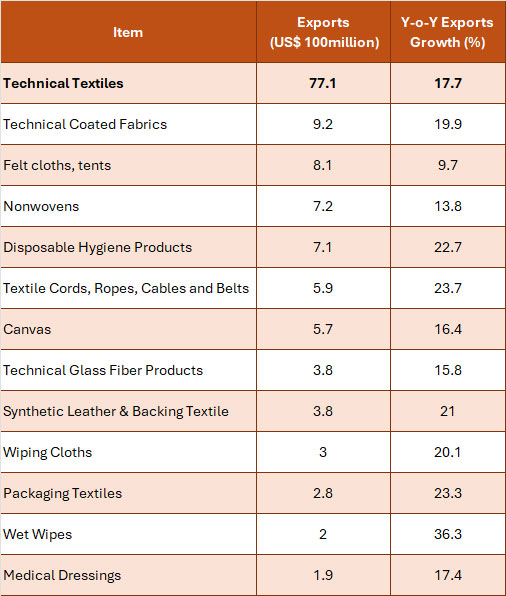
The industry’s exports grew relatively quickly. According to China Customs data, the export value of China’s technical textile industry reached US$7.71 billion in January-February 2026, up 17.7% year-on-year (as shown in the table); the industry’s import value was US$800 million, up 0.1% year-on-year.
Table: Export Performance of China’s Technical Textile Industry and Major Products in January-February, 2026
Source: China Customs
The United States, Vietnam, and Japan are currently the top three export destinations for China’s technical textiles. In the first two months of 2026, China’s export value to the United States was US$880 million, seeing a slight decrease of 0.7% compared to the same period last year; exports to Vietnam reached US$510 million, up 15.1% year-on-year; and exports to Japan were valued at US$360 million, growing by 4.9% year-on-year. During the same period, China exported US$4.66 billion worth of technical textiles to countries participating in the “Belt and Road” Initiative, seeing a year-on-year increase of 22.7%, accounting for 60.4% of the industry’s total exports.
Currently, the external environment facing China’s technical textile industry remains severe. Since late February, the geopolitical situation in the Middle East has escalated suddenly, disrupting global supply chain stability. Fluctuations in energy and shipping prices have exerted a phased impact on commodity price expectations. If the tense situation persists, on one hand, uncertainties in shipping costs and timeliness may increase pressure on the industry’s export logistics and fulfillment; on the other hand, prices of upstream chemical fiber raw materials, driven by sentiment in the crude oil market, may experience greater volatility. The potential impact of these factors on the operation of the technical textile industry requires ongoing monitoring.
Source: CHINA TEXTILE LEADER Express


Authority in Charge: China National Textile and Apparel Council (CNTAC)
Sponsor: China Textile Information Center (CTIC)
ISSN 1003-3025 CN11-1714/TS

© 2026 China Textile Leader, all rights reserved.
Powered by SeekRay