
2026/4/22
I. Economic Operation of the Technical Textile Industry in 2025
In 2025, the global economy exhibited a characteristic of “fragile resilience” under the combined pressures of continuous tariff impacts, high uncertainty in trade policies, escalating protectionist measures, and intensifying geopolitical tensions. Facing the complex changes in the domestic and international economic environment, China’s economy demonstrated steady, progressive momentum, vitality for new and improved development, and resilience in moving forward under pressure, showing a trend of “upward total volume and new growth drivers”. China’s technical textile industry actively responded to the complex external environment and fierce internal competition, accelerated its transformation and upgrading, and continued to maintain a positive development trend.
(I) Overall Good Capacity Utilization and Sustained Medium-to-High Growth in Production
In 2025, the domestic and international market demand for China’s technical textile industry steadily recovered. Among them, application markets such as wiping products, automotive supporting products, and wind power generation all saw growth rates exceeding 10%, maintaining a high level of growth; demand in the fields of environmental protection and infrastructure construction remained stable; and hygiene materials accelerated their development towards high-end and differentiated products. The sound development of key application areas provided solid support for the industry’s high-quality development.
The capacity utilization rate of the technical textile industry remained at a good level throughout the year. Especially in the second half of the year, the industry’s production index was in a rapid expansion range, and the output of major products maintained medium-to-high growth. According to the association’s survey, the capacity utilization rate of sample enterprises was 73.5% in 2025, with about 36% exceeding 80%.
According to the association’s statistics, the total fiber-processing volume of China’s technical textile industry reached 22.79 million tons in 2025, up 6.6% year on year. As the main raw material for technical textiles, China’s nonwovens output was about 9.21 million tons, up 7.5% year on year.
(II) Improved Profitability and Significant Divergence Among Sub-sectors
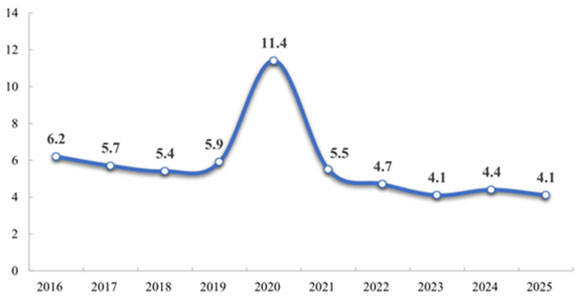
According to the National Bureau of Statistics, in 2025, the operating revenue and total profits of technical textile enterprises above designated size (non-comprehensive scope) decreased by 2.4% and 7.0% year-on-year, respectively. The industry’s gross profit margin was 15.1%, up 0.3 percentage points from 2024, while the operating profit margin was 4.1%, down 0.2 percentage points from 2024 (as shown in Figure 1).
Figure 1. Operating Profit Margin of Enterprises Above Designated Size in China’s Technical Textile Industry (%)
Source: National Bureau of Statistics
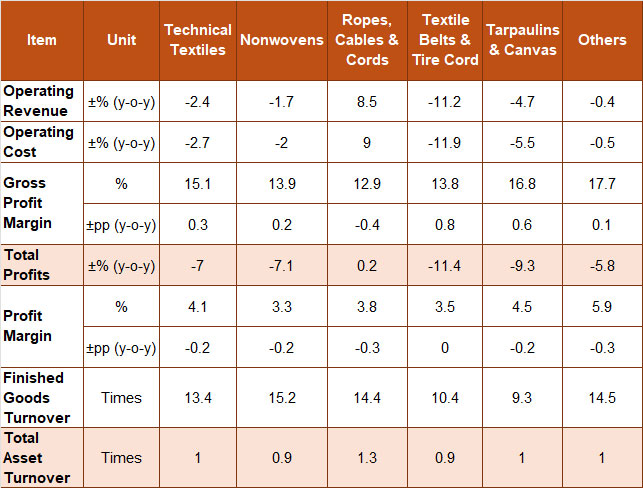
According to the National Bureau of Statistics, the main economic indicators for each sub-sector in 2025 were as follows (see Table 1).
Table 1. Growth Rates of Major Economic Indicators of China’s Technical Textile Industry in 2025 (Enterprises Above Designated Size)
Source: National Bureau of Statistics
(III) Recovering Investment Willingness and Continuously Strengthened Endogenous Power for High-Quality Development
In the past two years, investment in China’s technical textile industry has mainly focused on improving product quality, optimizing capacity structure, and promoting sustainable development. According to the association’s statistics from sample enterprises, investment in new projects has recovered significantly in 2025 compared to 2024, with approximately 77% having completed construction or implementation of new projects. Regarding capacity investment, taking nonwovens enterprises as an example, China is contracted to add approximately 70 spunbond/meltblown, 15 spunlaced, 140 needle-punched, and 25 thermal-bonded nonwovens production lines in 2025, with total new production capacity exceeding 700,000 tons.
Regarding investment plans for 2026, the association’s survey shows that sample enterprises’ willingness to invest continues to recover compared with 2025, with more than 80% planning to undertake new project investments or construction in 2026. Among these sample enterprises, the share of investment in upgrading existing equipment and intelligent transformation continues to increase compared with 2025, and the industry’s orientation toward high-quality investment is continuously strengthening. Some enterprises with scale advantages in the industry are also actively pursuing overseas market strategies, with Southeast Asia as a key focus.
(IV) Rising Protectionism and Resilient Industry Exports
Exports
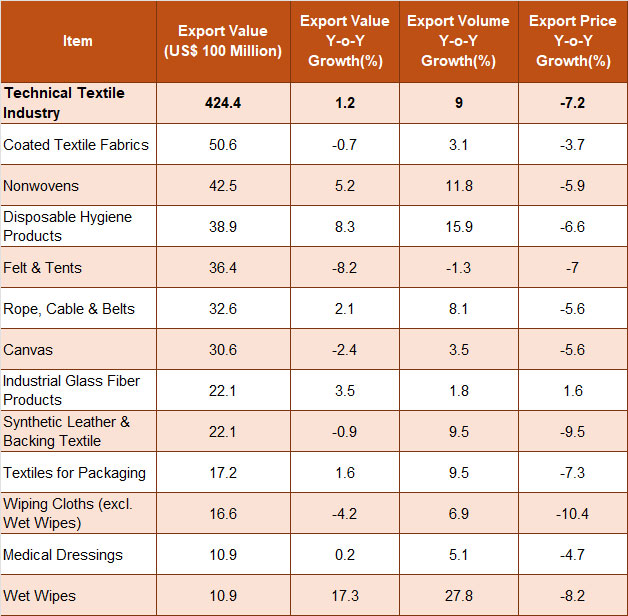
According to China Customs data, the export value of China’s technical textile industry in 2025 was US$42.44 billion, seeing a year-on-year increase of 1.2% (see Table 2), maintaining its position as the world’s largest exporter of technical textiles.
Table 2: Exports of China’s Technical Textile Industry and Major Products in 2025
Source: China Customs
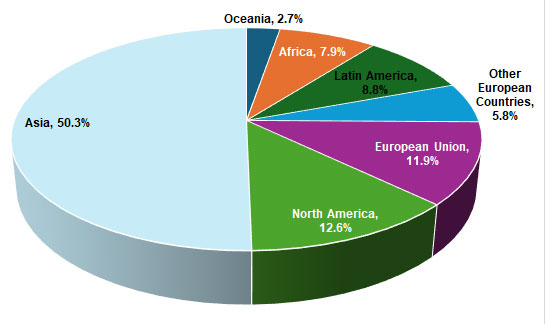
As for exports to major markets, in 2025, China’s technical textile exports showed significant divergence (as shown in Figure 2). Asia is the largest export destination for China’s technical textiles, accounting for 50.3% of the total export value, with exports to this region growing by 1.5% year-on-year. China’s exports to North America, the second-largest export market, decreased by 8.9% year-on-year, and its market share fell by 1.4 percentage points compared to 2024. Exports to the European Union and Latin American markets increased by 3.8% and 5.3% year-on-year, respectively, with market shares rising by 0.2 and 0.4 percentage points, respectively. The African market showed the strongest growth momentum, with exports increasing by 11.6% year-on-year, and its market share increase leading all major markets at 7.9%. Exports to Oceania decreased by 1.2% year-on-year, and the market share fell by 0.1 percentage points compared to 2024.
Figure 2. Major Export Destinations of China’s Technical Textiles in 2025
Source: China Customs
Imports
According to China Customs data, in 2025, the import value of China’s technical textile industry reached US$5.51 billion, up 3.8% year-on-year, marking the first recovered growth since 2021. Major imported products of China’s technical textiles exhibit divergent growth patterns (see Table 3).
Table 3 Imports of China’s Technical Textile Industry and Major Products in 2025
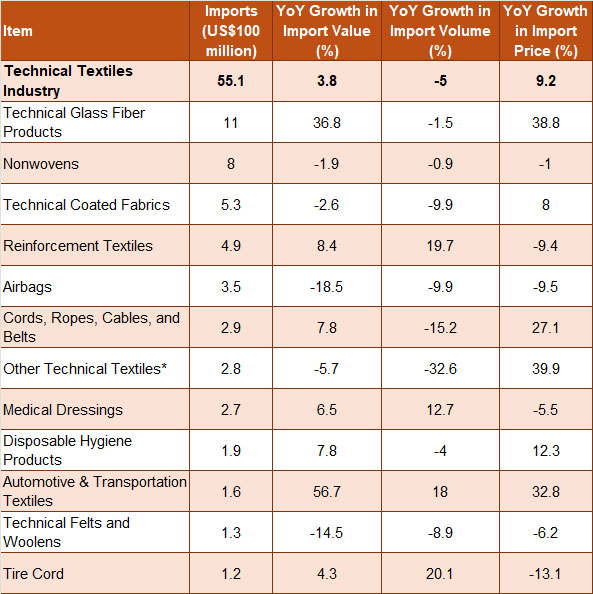
* Note: The category of other industrial textiles encompasses PMP hollow fiber membranes, specialized coated fabrics, filtration materials, polishing materials for semiconductor applications, and other technical fabrics.
Source: China Customs
II. Development Outlook for the Technical Textile Industry in 2026
2026 marks the first year of the “15th Five-Year Plan” and a critical year for comprehensively advancing the construction of a great country and the great cause of national rejuvenation through a Chinese path to modernization. China’s technical textile industry is about to enter a critical period of transformation, upgrading, and improving quality and efficiency, with strategic opportunities and risks coexisting.
Amid the ongoing impact of multiple shocks, global economic recovery will remain difficult and protracted. Uncertainty and volatility stemming from intensifying geopolitical conflicts, rising trade protectionism, and the regionalization of global supply chains will persist. In particular, the recent escalation of tensions between the US, Israel, and Iran not only heightens regional geopolitical turmoil but also carries profound implications for global oil supply dynamics and international shipping systems. This means that China’s technical textile exports will face mounting trade barriers, intensifying competition from emerging market peers, and shrinking margins for traditional products, while also navigating systemic risks such as volatile raw material prices and operational disruptions. However, deeper RCEP integration and high-quality Belt and Road development are creating new growth opportunities in emerging markets. Long-term trends, including the global energy transition, health system strengthening, and intensified environmental governance, will also generate sustained export demand for high-performance technical textiles.
Domestically, the first year of the 15th Five-Year Plan will see accelerated implementation of national strategic planning, providing a strong impetus for the high-quality development of China’s technical textile industry. Deepened new-type industrialization and efforts to build China into a manufacturing power will drive sustained growth in high-end demand across new energy, infrastructure, biomedical applications, and aerospace sectors, effectively resolving structural supply-demand imbalances in the industry. Policies supporting technological innovation, green and low-carbon development, and the private economy will continue to yield results, accelerating the industry’s digital transformation and green transition, and promoting a shift in enterprise development models from scale expansion to quality enhancement.
Source: CHINA TEXTILE LEADER Express


Authority in Charge: China National Textile and Apparel Council (CNTAC)
Sponsor: China Textile Information Center (CTIC)
ISSN 1003-3025 CN11-1714/TS

© 2026 China Textile Leader, all rights reserved.
Powered by SeekRay